Manuel Antonio Noriega ruled Panama with secret police, torture, and intimidation. Noriega actively funneled drugs to the United States, Colombia, Guatemala, and Mexico, was in bed with the Medellin cartel of Colombia (Pablo Escobar’s gang) — and was paid more than $300,000 by the CIA for his hard work.
After US officials indicted Noriega in 1988 for drug trafficking, racketeering, and money laundering, his defense lawyer claimed his CIA payment was closer to $11 million.
The 1980s were rife with drugs and arms shipments that kept federal agents chasing drug cartels, as well as one another. According to news reports, witnesses alleged that a CIA operative played a role in the 1985 murder of a DEA agent. For its part, the Drug Enforcement Administration sometimes hunted CIA-funded drug shipments from South America to Los Angeles.
During this turbulent era, Noriega’s regime remained one of the most significant contributors to the drug trade between the US and Panama. But Noriega’s hold on the drug trade faced a homegrown threat. During a meeting with DEA agents at the US Embassy in Costa Rica, Hugo Spadafora, a Panamanian physician and vocal critic of the regime, claimed he had evidence against Noriega. After he spoke with DEA agents, Spadafora’s tortured body turned up headless inside a postal bag in a Costa Rican ditch on Sept. 13, 1985.

The National Security Agency caught a snippet of a phone call between Noriega and Maj. Luis Córdoba, of the Panama Defense Forces, that ultimately gave the US the leverage they needed to prove Noriega was behind Spadafora’s assassination.
As supervisor of the torture session, Córdoba called Noriega — in Paris — on a $5,000-per-day satellite phone line to let him know: “We have the rabid dog.”
Noriega responded: “And what does one do with a dog that has rabies?”
According to In the Time of the Tyrants, a 1990 book that covers Panama’s power struggles, Noriega’s comment was a coded instruction for Córdoba to torture and decapitate Spadafora.
The brutality of the Spadafora murder changed the US attitude toward Noriega. Thereafter, US officials considered the Panamanian dictator uncontrollable — and his brutality was a public relations liability.
Noriega quickly lost favor within US political circles. And in 1988 the US indicted him for federal crimes, spurring a US effort to retrieve the Panamanian strongman.

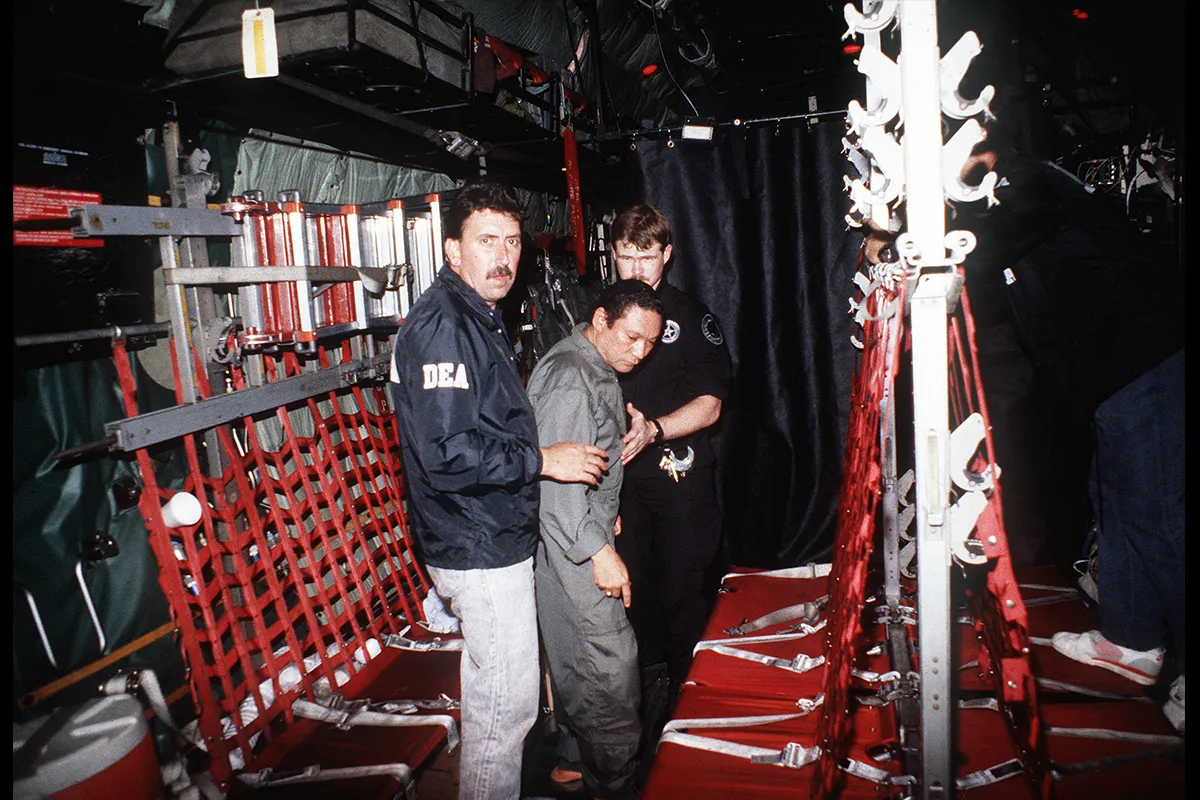
The 1989 US invasion of Panama — Operation Just Cause — destroyed Noriega’s “dignity battalions,” rescued political prisoner Kurt Muse the day before his execution, and captured Noriega after he’d barricaded himself within the Vatican Embassy in Panama City for almost two weeks.
According to The Guardian, “Following a series of incidents that culminated in the death of an American soldier, President George Bush decided it was time for regime change. In December 1989, Bush sent in US troops to overthrow Noriega, offering a $1m reward for information leading to his capture.”
Noriega surrendered to US forces and was taken into custody on Jan. 3, 1990.
Noriega faced trial in the US, as well as charges in France and Panama. He was sentenced to imprisonment in the US and was eventually convicted “in absentia” of other crimes in both France and Panama. A Panamanian court found Noriega guilty of murder in 1995.
Noriega was extradited to France in 2010, where he served time in prison. In 2011, the French government granted Panama’s extradition request, and Noriega was sent home. He died from complications of a brain tumor in 2017. At the time of Noriega’s death, the Panamanian government had already released the former dictator from prison and placed him under house arrest.
Read Next: